
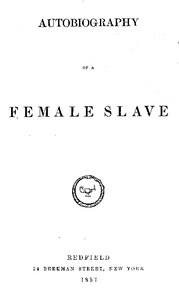
Autobiography of a Female Slave by Martha Griffith Browne
Let's get the unusual part out of the way first. Published in 1856, this book presents itself as the true life story of a woman named Ann, born into slavery in Kentucky. In reality, it was written by Martha Griffith Browne, a white woman from the South who became an abolitionist. She used the voice of a Black woman to argue against slavery, which is a literary choice that modern readers will rightly scrutinize.
The Story
The narrative follows Ann from a relatively sheltered childhood, where she's unaware she's enslaved, into the harsh reality of being sold away from her mother. We see her life through multiple owners—some indifferent, some cruel. The story details relentless work, constant fear, and the ever-present threat of violence, particularly sexual violence. Ann learns to read in secret, a dangerous act that becomes a lifeline. Her deepest desire isn't just for physical escape, but for the basic human connections slavery denies her: to keep her family, to love freely, to own her own body and thoughts. The plot is a relentless journey through the grinding machinery of slavery, showing how it breaks bodies and tries to break wills.
Why You Should Read It
This isn't an easy book. The descriptions of beatings and degradation are hard to take. But its power lies in its psychological detail. Browne, through Ann, tries to show the internal world of someone treated as property—the humiliation, the strategic silences, the fleeting moments of joy, and the fierce, private rebellion of the mind. Reading it, you're constantly aware of the complicated filter: a white author imagining a Black experience for a white audience to stir conscience. That tension is part of what makes it so fascinating. It's a historical artifact of abolitionist literature, full of the raw anger and persuasive intent of its time.
Final Verdict
This book is for readers interested in the messy, complicated history of how America has talked about slavery. It's not a replacement for actual slave narratives like those by Frederick Douglass or Harriet Jacobs, but it should be read alongside them. It's perfect for book clubs that don't shy away from tough conversations about authorship, race, and historical fiction. If you approach it with a critical eye, understanding its origins and its goals, 'Autobiography of a Female Slave' offers a raw, angry, and unforgettable window into the past.
Paul Flores
1 year agoI came across this while browsing and it challenges the reader's perspective in an intellectual way. This story will stay with me.
Jackson Williams
3 months agoFive stars!
Jackson Smith
1 year agoEnjoyed every page.
Paul Anderson
1 year agoThe index links actually work, which is rare!




Liam Scott
1 year agoLoved it.